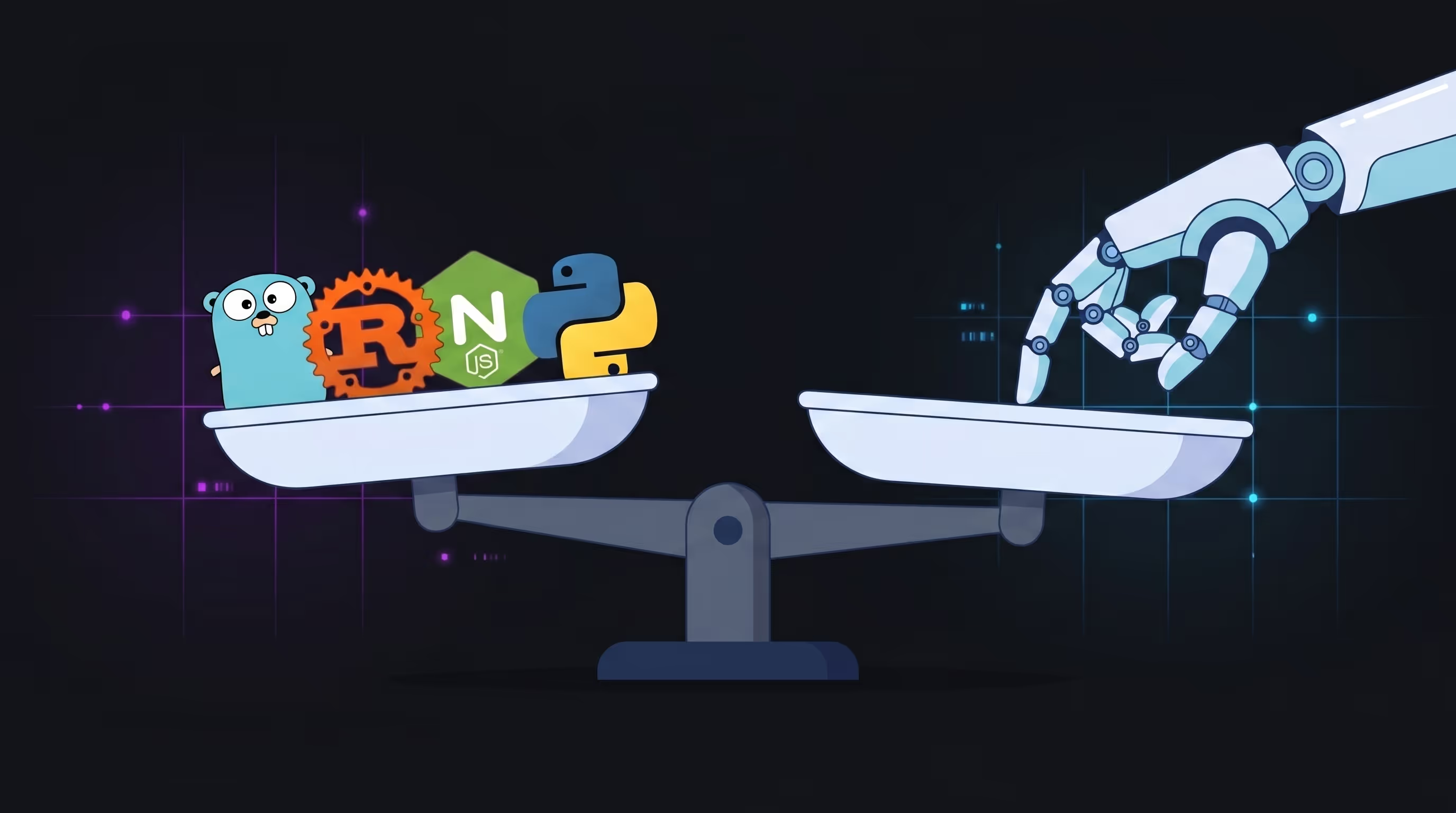
When selecting a programming language for a project, developer availability has traditionally been one of the most important criteria. For instance, when building high-performance systems, many teams chose Node.js over Go. Despite Go’s superior raw performance and concurrency handling, Node.js won out because it had a larger talent pool and quicker development cycle.
Today, the landscape is shifting. AI-assisted coding agents have transformed the equation. Developers can rapidly generate code across languages, making availability less of a bottleneck. What’s coming to the forefront now is a balance of performance, tooling, and purpose.
High-Performance Systems
Consider high-performance software. Teams traditionally defaulted to Node.js for its speed of development, but today, Go, or even Rust, makes more sense when raw speed is crucial. Both deliver exceptional performance, making them ideal for high-throughput systems.
Code Confidentiality in Proprietary Software
Think about proprietary software where code confidentiality is a priority. Interpreted languages like Node.js or Python expose source code, which can be a risk. In these cases, compiled languages like Go or Rust give us that critical layer of obscurity, ensuring the code is harder to reverse-engineer.
The Right Tool for the Right Job
No single language wins everywhere, and that’s the point. Each language has evolved to serve a purpose well.
Python continues to dominate in machine learning, data pipelines, and scripting. Its ecosystem of libraries and frameworks in that space is unmatched. Go shines in building microservices, CLI tools, and network-heavy applications where simplicity and concurrency matter. Rust is increasingly the go-to choice for systems-level work, performance-critical components, and anywhere memory safety is non-negotiable. Node.js remains excellent for rapid prototyping, real-time applications, and scenarios where sharing code between frontend and backend adds value.
The key is matching the language to the problem domain rather than forcing a familiar tool into every situation.
Ecosystem Maturity and Community Support
A language is only as strong as its ecosystem. When evaluating a language, it’s worth looking beyond syntax and performance benchmarks. How mature are the libraries? How active is the community? How well-maintained are the frameworks you’ll depend on?
A language with a rich, battle-tested ecosystem can dramatically reduce development time. Conversely, choosing a language with a thin ecosystem, no matter how performant, can mean writing and maintaining more code from scratch. The strength of a community also determines how quickly security patches ship, how easy it is to find solutions to common problems, and how smoothly new developers can onboard.
Deployment Targets Matter
Where your software runs should influence the language you write it in. Cloud-native deployments, edge computing, embedded systems, and serverless platforms all have different constraints.
Some languages produce smaller binaries, consume less memory, or cold-start faster. These are factors that matter significantly in containerized and serverless environments. Others have better support for cross-compilation or specific hardware targets. It’s worth considering whether your deployment target favors, or even limits, certain runtimes. Cloud providers sometimes offer better integration, faster cold starts, or lower costs for specific language runtimes, and that can quietly influence your architecture over time.
The AI Nuance: Writing Code is Not the Hard Part
AI-assisted coding has made it remarkably easy to generate code in almost any language. But writing code was never the hardest part of software engineering. The real challenges lie in maintaining, debugging, and operating that code in production.
AI can scaffold a service in Rust in minutes, but when something breaks at 2 AM, your team needs to understand the code well enough to diagnose and fix it. Adopting a language solely because AI can write it fluently is a trap. The team must still be able to own the codebase. Review it, extend it, and debug it under pressure. AI is a powerful accelerator, but it doesn’t replace the need for genuine understanding.
Long-Term Costs: Beyond the Initial Build
Language choices have compounding effects over time. Hiring for maintenance is a practical reality. Some languages have a deeper talent market than others, and that still matters when you need to scale a team or replace departing members.
Library and framework longevity is another consideration. Building on a framework that loses community momentum can leave you with mounting technical debt. And while it’s easy to overlook, vendor lock-in through language-specific cloud services or proprietary integrations can quietly constrain your future options.
These aren’t reasons to avoid any particular language, but they’re worth factoring into the decision, especially for systems expected to run for years.
Conclusion
The old paradigm of favoring developer availability above all still has its place, but the decision matrix is richer now. AI tools have lowered the barrier to working across languages, giving us more freedom to choose based on what truly matters: performance, security, ecosystem strength, deployment fit, and long-term maintainability.
There’s no universal right answer. The best language choice is the one that aligns with your problem domain, your team’s ability to operate the system, and the constraints you’ll live with over time. Choose deliberately.